From Order to Door: Redesigning the Delivery Experience

overview

The project came from the need to make partner deliveries more efficient and reliable. Inefficient internal steps in the app left room for Proof Not Received (PNR), when the customer pays but disputes the delivery due to lack of proof.

The redesign simplified friction points and strengthened delivery evidence, bringing clear results: an average reduction of 7–8 seconds per stop, up to 2 taps eliminated, and record compliance increasing from 92% to 98%, with an expected 30–40% drop in PNR disputes.

Team

Matthias Karl Schaefle

Scope of work

User research; UI design.

role

UX/UI Designer

year

August, 2025

The Problem

Although the main flow was clear, the internal steps required extra effort. Drivers had to manually type certain fields and repeat information, which increased the time per stop and left room for Proof Not Received (PNR).

Highlights

The redesign focused on simplifying the experience and strengthening delivery proof. The outcome: smoother stops for drivers and greater confidence for the company.

research

Small frictions, big impacts

I conducted field research by shadowing 5 drivers on real routes and later spoke with each of them about their in-app experience. What seemed like a small detail turned out to be a recurring pattern.

01

Repeated typing

Drivers had to retype data already in the system, such as documents or recurring notes, which increased the time spent at each stop.

02

Manual records

In stores, packages were often received by coworkers, but without an option in the app the driver had to type it manually, leading to inconsistent records.

03

Photos that lacked trust

Many images were dark, blurry, or didn’t show the correct building front, weakening the proof of delivery.

04

Proof not received (PNR)

Many PNR cases happened because drivers didn’t fully describe who received the package, leaving room for doubt and disputes.

From problems to insights

You can see my thoughts hovering the lights 🙂

Recognizing that our desk research left gaps, we surveyed 164 Brazilian pet owners about scheduling veterinary appointments, leading to key reflections and deeper questions for user-centered solutions.

💡

This number stands out. I wonder how satisfied people are with booking their appointments through WhatsApp?

💡

And what is the experience of taking a pet to the vet in emergency situations like?

💡

It's a big number and shows that proximity matters to a lot of people. This points to a need to explore, but it's not time to think about solutions yet.

56%

Scheduling via Whatsapp

Represents the number of pet owners who schedule appointments through the app.

52%

Take only when they show symptoms

Some pet owners schedule regular check-ups, while others seek care only when their pets show symptoms.


63%

Nearby veterinarian

Represents the percentage of pet owners who take their pets to the nearest veterinarian.


Connecting data and stories to impactful solutions

To clarify the questions from the previous phase, we conducted interviews that connected data to real stories, revealing pet owners’ pain points.

Type: In-Person
Location: Brazil
Participants: 5 (20-40 years old)
Duration: 15 to 25 minutes each


We chose the pet owners’ demographic profile based on insights from our desk research and survey.

01

Annoyed

Scheduling via WhatsApp is inconvenient, with responses sometimes taking up to an hour.

02

Search struggle

Pet owners have struggled to quickly find clinics and veterinarians offering emergency services.

03

Forgetfulness

Remembering appointments and vaccine dates is difficult due to busy lifestyles and no reminders.

04

Convenience

Most people prefer to go to the nearest veterinary clinic for convenience.

Small UI changes, big UX impact

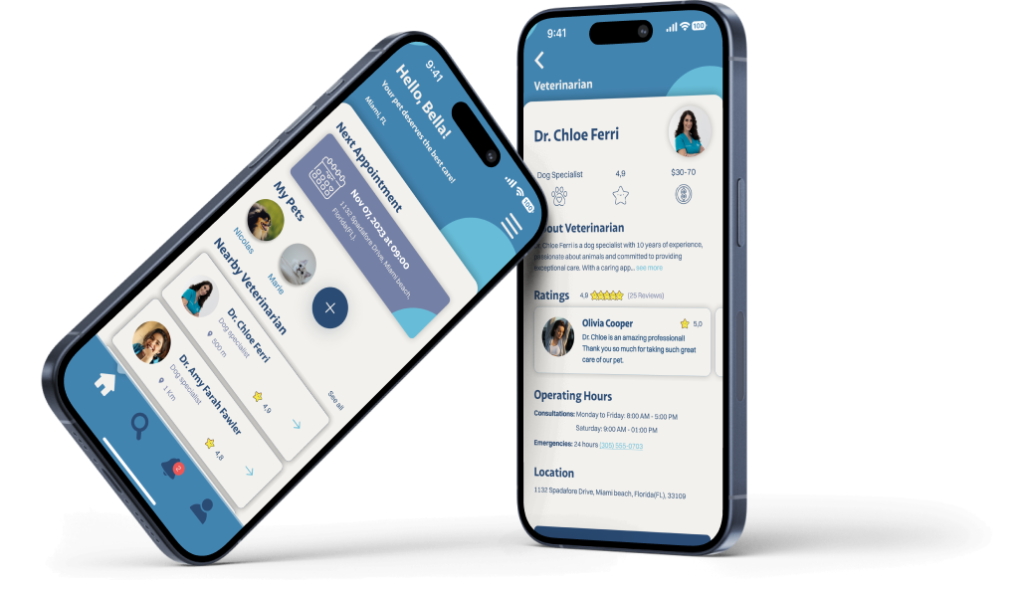
We created mid-fidelity wireframes and tested them with 3 pet owners, simulating the booking process and making adjustments based on insights.

01

Users had difficulty finding key information in the veterinarian's profile.

Solution: We redesigned the veterinarian profile for easier identification and alignment with other pages, enhancing app usability.

02

Participants struggled with navigating the integrated calendar.

Solution: We chose to implement a simpler, more recognizable calendar on a separate page to improve focus and clarity.

03

Users need quick and easy access to appointment details.

Solution: After an appointment is made, the section “Next Appointment” appears on the home screen.

Streamlining appointment scheduling

In the second high-fidelity test, we evaluated our app’s efficiency compared to competitors, focusing on a common concern among pet owners: the time it takes to schedule appointments. 5 pet owners booked appointments using the Vets and MeuPet apps, the most downloaded in Brazil, before trying ours.

Due to time constraints for the case study, the sample size was small, but the initial test showed a promising efficiency improvement.

We aimed for our app to be 10% faster at scheduling compared to competitors

Result: Our solution exceeded expectations, with an average scheduling time of 45 seconds.

15,9%

faster than competitor apps.